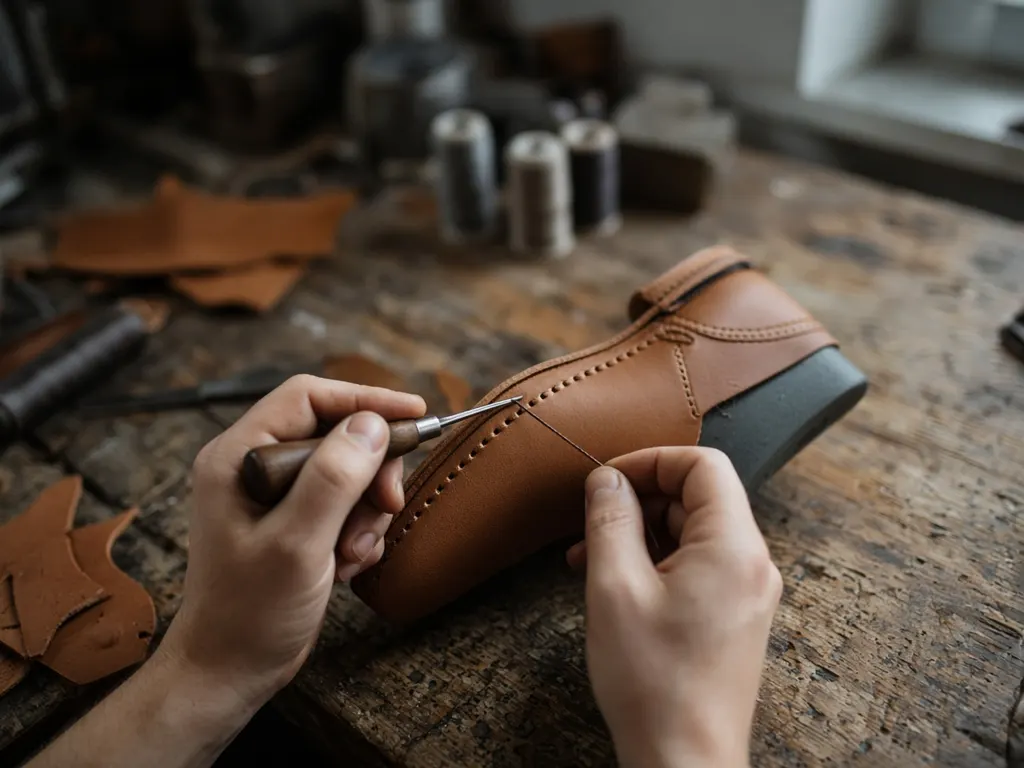
First-person video of skilled hand work
Head- and chest-mounted cameras capture what the operator sees and does, step by step, across full task cycles.
- Upper stitching
- Lasting
- Sole bonding
- Leather cutting
- Finishing
- Hand assembly
We capture skilled manual work on working production lines at partner factories, and we label video and images, ours or yours, with annotators who know production. Consented, rights-cleared and delivered to your spec.
For humanoid and robotics teams, physical-AI and AI labs, and machine-vision engineers.
Illustrative labels. Real schemas follow your guidelines.
What we collect is hard to get from a lab: real people doing real production work, filmed the way your model needs to see it.
Head- and chest-mounted cameras capture what the operator sees and does, step by step, across full task cycles.

Overhead and station cameras on production lines, with consistent angles and lighting for process and inspection models.

Stitching faults, bonding gaps, glue overflow, colour and material flaws, shot at the inspection station.
Tell us the tasks, camera rig, resolution, frame rate and hours you need. We plan the shoot around them and agree it in writing first.
A service of its own: we label footage and images you already have, or the data we collect for you. Our annotators know production, so they can tell lasting from pulling over and a cosmetic mark from a real defect.
{
  "clip": "fw-stitch-sample",
  "task": "hand_stitch_upper",
  "view": "egocentric/head",
  "segments": [
    { "step": "position",    "t": [0.0, 2.4] },
    { "step": "pierce",      "t": [2.4, 4.3] },
    { "step": "pass_thread", "t": [4.3, 8.1] }
  ],
  "hands": {
    "left":  { "grasp": "awl" },
    "right": { "pull": "thread" }
  },
  "anonymised": true,
  "consent": "on_file",
  "reviewed": "second_pass"
}
Illustrative structure. Formats such as COCO or your own schema on request.
We quote after looking at a sample of your data and your guidelines.
Have data that needs labelling? Tell us what it is and how much.
Request labellingWe know these processes from the inside, so we can name every step, film it properly and label it with the right vocabulary. Pick an area to see what we cover.
Cutting upper parts from the hide by knife or die press, reading the skin to avoid flaws and follow its stretch.
Thinning leather edges on a skiving machine so seams, folds and overlaps lie flat.
Stitching the upper together on flatbed and post-bed machines: vamps, quarters, linings, reinforcements, eyelets.
Pulling the upper over the last and fixing it to the insole at toe, sides and heel, by hand with pincers or by machine.
Attaching the sole. The construction method changes the hand work completely; we cover each one below.
Trimming threads, cleaning, edge inking, polishing, inserting socks and laces, final inspection and boxing.
Building the pattern pieces and scaling them across the size range.
Nesting pieces on the fabric width to use the cloth efficiently and respect grain and nap.
Laying plies, aligning edges and patterns, and cutting stacks by straight knife, band knife or by hand.
Guiding soft, shifting fabric through the machine with both hands, across the operations below.
Opening seams, setting creases and shaping with irons and presses.
Buttons, zips, snaps, labels and tapes, attached by hand or on dedicated machines.
We label to your defect taxonomy and severity scale, or build one with you during the pilot.
Leather, fabric and foam bend, stretch and fold. That is exactly the gap in most manipulation datasets.
Nearly every step needs two coordinated hands: one holds and tensions while the other works.
A single shoe line runs dozens of distinct manual operations, so one site gives broad task coverage.
Steps follow a fixed order with defined start and end states, which maps cleanly onto segmentation labels.
Inspection stations sit on the same line, so the work and its outcome, good or defective, can be captured together.
Start small, check the data fits, then scale.
A short call on what you need: footage collected, your data labelled, or both. We pin down tasks, setup, volume, label schema and rights.
We capture or label a small batch so you can test it in your pipeline before committing to volume.
Scheduled shoots in partner factories with consent gathered on site, and labelling to your guidelines with second-pass review.
Batches land in your bucket or labelling tool with documentation. We add edge cases as your model finds them.
Labelling on its own is a commodity. Access to the work itself is not.
Footwear is one of the most hand-intensive industries left. We work with factories that still do this work by hand, and they let us film it.
We come from footwear manufacturing. We know which steps matter, what a defect looks like, and how to film without stopping the line.
Capture and labelling teams work US business hours and share your working day, so feedback loops take hours, not overnight.
Signed participant consent, anonymised faces and identifying details, factory IP review, and a documented chain of rights for every dataset.
We film and label to your spec. Tasks, rig, volume and rights are agreed up front, and exclusive arrangements are possible.
License footwear and hand-work datasets from our collections, each with documentation and consent records.
We label data you already have, or data we collect, priced per hour of video, per label or as a pilot batch.
Not sure it fits? Start with a small paid pilot or a sample, for collection or labelling, before you commit.
Request a sample datasetSomething we haven't covered? Add it to your sample request and we'll answer it on the scoping call.
At partner facilities, on working production lines. Locations, sites and consent documentation are shared under NDA. We film with each factory's permission and each participant's signed consent.
We agree rights in writing before capture. Custom collections can be licensed exclusively to you. Licensed datasets come with a defined, documented licence.
Faces and identifying details are anonymised before delivery. Factories review what is filmed so confidential designs and processes stay out of frame, and consent records are kept for every participant.
Yes. Labelling is a standalone service. Send footage or images from your own capture and we label them to your guide and taxonomy, in your CVAT or Labelbox workspace or ours. We can help you write or tighten the guide during the pilot.
Per hour of video for segmentation and interaction work, per label or per image for boxes, masks and defect classes, or as a fixed pilot batch. We quote after looking at a sample of your data and guidelines.
Video and images at the resolution and frame rate you specify, with labels in your schema or CVAT- and Labelbox-compatible exports such as COCO, CVAT XML or NDJSON, delivered to your storage bucket or tool.
Footwear and leather goods are where we start, because that is where our access and expertise are deepest. We can also scope cut-and-sew apparel and other hand-assembly work, and our labelling service works on data from any manufacturing category. See Craft & capabilities.
We scope a small batch with you, capture and label it, and you test it in your pipeline. If it fits, we plan volume from there.
Share the tasks, data, volume and timeline. We'll come back with a sample and a plan for a pilot.